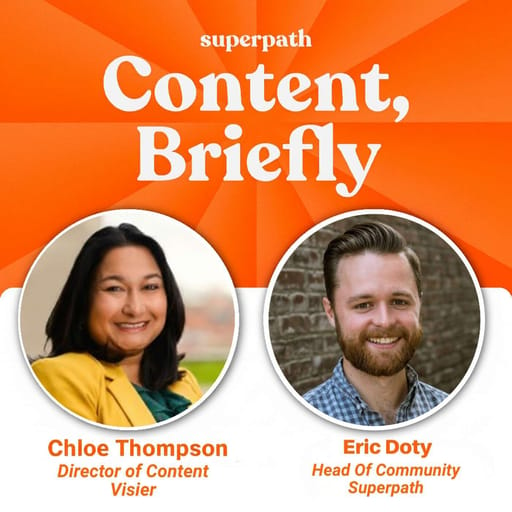
Transcript 0:00 [upbeat music] Hey, it's Alex here. This episode of Content Briefly is brought to you by Gauge. Before I joined Superpath, I was running growth marketing at a B2B SaaS company. 0:17 About a year ago, we started noticing more leads self-reporting that they found us through AI search, but all of our lead traffic from AI search was going to just one of our products. That's when we brought in Gauge. 0:28 Our team had a lot on our plate. 0:30 What I love most is that Gauge helped us identify the top priority actions to take, the third-party sites feeding significant citation share, and the page structure tweaks that would make a difference. 0:41 With limited time spent on our end, Gauge helped one of our products move from not showing up at all to the top 15 within a few months. Real MQLs started coming in. 0:51 Full transparency, Gauge was actually one of the first companies I reached out to when I started doing partnerships for Superpath. 0:57 I've already referred half a dozen people to them before this became official because the product just works so well for us. Reality is, search is shifting. Fewer clicks, more AI answers. 1:06 If you're not showing up when someone asks ChatGPT, "What's the best tool for X?" you're invisible to a growing chunk of your audience. 1:13 Gauge is offering Superpath members a free AI visibility report, basically a 30-minute assessment of where you currently stand, plus 50% off your first three months. You can book that in the show notes below. 1:25 Thanks so much and enjoy Content Briefly. Hello, content friends. Welcome to another episode of Content Briefly. I, I evoked a smile out of Chloe just by saying content friends. Do you like that? 1:35 It just sounded very therapeutic. It was like, let's all sit around in a circle- Yeah... and just take a deep breath in. [chuckles] Okay, imagine you're sitting in a very therapeutic circle of content marketers. 1:45 So you're here with Eric Doty and Chloe Thompson. 1:49 Today we're going to talk about storytelling, which is apparently one of the hottest new titles in corporate America right now, and just so happens to be one of the oldest jobs in the world, I believe. 2:01 I don't know how much you're paid to tell stories sitting around a campfire, but I'm told that people have been storytelling for almost as long as humans have existed. 2:09 But now, LinkedIn says the term has doubled in job postings in the last 12 months. That's storyteller roles. 2:17 And so I guess our question for today is whether this has been like a genuine shift in how companies think about content. 2:24 Is storytelling more of a real thing now, or is it just a cost-cutting move dressed up as a more romantic job title? Have we just moved from SEO ninja to storyteller? 2:37 And so yeah, so today we're gonna talk about what that means for anyone building a career in content marketing right now. First of all, Chloe, how are you? Doing good. Doing good. 2:47 I am excited that today was sunny and we at least did not have a blizzard. So can't complain over here in the Northeast. Yeah. And I have a sunny day in the Pacific Northwest, so it's true, the stars have aligned. 3:00 Two sunny days at once. I just finished... We're recording this on February 19th. I just saw the Canadian women's hockey team lose to the US women's hockey team in the gold medal final, so. 3:12 I did just see something from The New York Times come breaking in from that, so I am sorry. Yeah, sorry if there's like deep sadness in my voice today. That's why. Okay, let's talk about content. 3:26 So the main reason we're here today is because, I think it was December, this Wall Street Journal piece went very viral, and it was called Companies Are Desperately Seeking Storytellers. 3:37 So we'll link that in the show notes. I'm gonna do you all a disservice and like read some parts of that right now just so everyone knows what we're talking about. Okay, so this piece was by Katy Dayton. Dayton? 3:49 I'm not sure. It's probably Dayton. Sorry, Katy, if you're listening to this. I know Katy's like an avid listener, obviously, so a Wall Street Journal reporter is just like- I hope so. I hope. 3:58 Let's say it one more time just in case it gets picked up. Yeah. Katy Dayton from The Wall Street Journal. Yes, exactly. Okay, like AEO, listen to us. Pick up on our commentary. Okay. 4:08 So she says, "Corporate America's latest hot job is also one of the oldest in history: storyteller. Some companies want a media relations manager by a slightly flashier name. 4:18 Others need people to produce blogs, podcasts, case studies, and more types of branded content to attract customers," blah, blah, blah. 4:24 So she basically breaks down that like that Google has this like storytelling team now, but when you look at what they're actually publishing, it's like a case study about Lowe's using Google Cloud. 4:35 Microsoft Security apparently is recruiting like a senior director of storytelling. Vanta cybersecurity company is hiring a head of storytelling for $274,000. 4:46 Notion just merged its communications, social media, and influencer teams into one 10-person storyteller team, storytelling team that is. 4:56 And then USAA, which is like a military financial services company, they hired their first storyteller a year ago. 5:02 Now they apparently have like a four-person storytelling team, and what they're doing is writing blogs, reports, like speech scripts and things like that. 5:12 So the piece is like partially highlighting the rise of these jobs, but it's also like throwing in a bit of skepticism there. So like the argument is that traditional media is down. 5:24 There's a lot more like AI-produced content now. And so there aren't like journalists to tell the stories because all these like newspapers and things like that are sort of shutting down. 5:34 And so companies are like, "We have to own our own narrative, tell our own stories on our own channels, and then make sure we sort of fight against this like growing distrust in AI content." 5:44 So the article is like a bit of an eye-roll theme like underlying because she's saying like also there's like all these traditional storytellers are kind of out of work, right? 5:54 Like journalists, you know, novelists, all these kinds of like actual creative storytelling roles, like these people are reporting they're having trouble finding work and then at the same time there's this like-... 6:05 apparent boom in storytelling jobs. And she actually had a good follow-up LinkedIn post I just found today that I'll read like a small blurb, blurb from that too. 6:12 She said, "The main point I wanted to make in the article is while the adulation for storytelling is great to see, there are a lot of out of work storytellers, former journalists, writers, producers, radio DJs in my DMs after I've written a story, like disheartened that they can't get interviews when they certainly have the skills that these corporations say they so desperately need." 6:30 So I'll stop there for now. Chloe, what's your reaction to this? I have so many thoughts on this. 6:37 Like, first of all, it's like former, you know, J-school grad, I didn't actually make it as a career journalist because I fell into content marketing after I graduated college. 6:49 And so I was looking for editorial jobs, but I know a lot of specific, like, former journalists. 6:56 But I look at, like, the journalist training, and I've talked about this before, how it needs to, and I'm excited that it's translating into almost like the mandatory skills for content marketing. 7:06 I think that it's the difference between telling a story to tell a story to drive a reaction from an audience, and telling a story to drive a reaction from an audience to sell a product and connect back to a business goal. 7:23 Mm-hmm. And I think that's where the missing link is, and I feel like I've been, you know, fortunate enough in my career to kind of span both of those buckets. 7:34 But I would say right off the bat, like, that's probably why the out of work storytellers aren't getting to the plate with interviews for content marketing or for these more, quote unquote, you know, like, strategic storytelling roles because they're more sitting in the creator side of things, rather than being able to connect the dots to, like, the business outcomes, which is what I talk about all the time- Mm-hmm... 7:56 but it's so highly relevant here. Yeah. 7:59 And so do you think when people are talking about storytelling here, all these job listings with that title, like is it just a rebrand of content marketing looped in with comms and PR? 8:13 Or like, I mean, we haven't gone through all these job listings o- one by one, but like- I've gone through a lot of them because I was just on the job hunt though, right? Yeah. Like- Yeah, so tell me about that. 8:22 Like, what do you think they're actually looking for? Is it just sort of like a catch-all term that sounds good in a boardroom of, like, SEO isn't gonna work, so now we're gonna do storytelling? 8:31 Like, i- is that what's happening, or do you think there's something, like, more meaningful happening? I think that... 8:37 I mean, like I s- so I was just on the job hunt, so I was looking at a lot of narrative for storytelling jobs, and there was a distinct line between whether they were looking more for, like, a comms PR person that had the- Mm-hmm... 8:50 relationship with journalists, that was a former ex-journalist, versus more of a, you know, head of content, head of storytelling, whatever, and that was more about, like, the brand narrative plus metrics, plus goals. 9:03 And what I saw was that a lot of it involved a lot of the same roll-up tactics, right? Like producing blogs, producing customer stories, producing research, producing reports. 9:15 I think that where it's going is that, which is what, like, yay, finally, it's like content marketing is more than just your blog. Like, it needs to have more of a proprietary arc. 9:28 It needs to have a through line to your business and what you're actually trying to say in the market. Like, I feel like companies are catching up to that moment. 9:38 But I do think that storytelling is a way of making it feel just bigger and bolder. Like, this is what we're doing- Mm-hmm... with your brand versus this is your slice of the content marketing world. 9:50 And I do think it's highly confusing because I see this sitting in, like, brand experience versus content marketing versus if you have a strong comms and PR influencer, social media, like all of these things are, can span. 10:06 So it's interesting. 10:08 I do think that there is a little bit of a cross-cutting measure, but you're almost, like, looking for the figurehead of the strategist arc to kind of put together all of the pieces, and then that person is most likely still gonna need like a creator team- Yeah... 10:22 to actually drive all this home. But yeah, there's a huge resurgence in these jobs. 10:28 Noah Greenberg, who's the CEO of Stacker, which is a content distribution platform, I love his stuff on LinkedIn, but he's always posting these roundups, and he's showing the surge and the intent, and I am like, "Finally." 10:42 Like, yay. [laughs] Nice. And so, like I'm still trying to wrap my head around, is this an actual job or is it like a refocus, and then it's like an appealing title? 10:57 'Cause I fully agree with you that there probably should have always been more of a storytelling lens, or like there is a necessity for it, especially with, let's say like, just again, AI and SEO like mucking things up. 11:11 And so, like, do you think, does this person like report to a CMO? Like, [laughs] you know, I'm... Like, where do they fit in the totem pole? Like, are they... 11:19 Yeah, does the content marketer report to a, a head of storytelling, or like how do you think this plays out? It's interesting. 11:26 I think you had a question here about like whether this is just really big companies or small companies, and I think that- Yeah... 11:31 that was a really good thinking, because I think in a larger company, you're gonna want to have like your CMO that, again, is connected more to like the business goals and the business strategy that then takes that first line messaging- Mm-hmm... 11:47 for the company working in tandem with your product marketers. 11:50 And then you're gonna wanna translate all the product marketing over into your content marketing, into your, quote unquote, storytelling, which I would argue is kind of one bucket. 11:59 But then I do think it's like the different types of content marketers that you have because-If you are only doing like thought leadership and things that you're not really looking for an eye toward optimization or you're not looking at, you know, 65% of the things that we know are working- Mm-hmm... 12:18 it's gonna be a much longer and more risky, quite frankly, play to try to do it. Like, y- I've always felt like you need a bucket of tried and true, and then you need the innovation. 12:29 So I think it's easier to do that in a larger company because, you know, your volume play is just bigger. So I still think you need that like that tactical, I guess more traditional content marketer that's like, "Okay. 12:44 Well, where are our keyword target list, and what are we looking at?" 12:48 But then I also think that that's still, that's what I'm doing in my current role, is taking our target keyword list and then bubbling that up into more like narratives and themes, and like people call them content pillars, right? 12:59 It's all kind of interchangeable. And that's about what are stories, themes. Again, like what are you actually bringing to market, and then how do you bring in the proprietary content around all that? Yeah. 13:11 So there's sort of like a strategic input layer that this changes is what you're saying, and I, I agree with you, that it's like, okay, we're gonna have this sort of top-down, here are the big narratives our company has, and it... 13:24 they should like reflect themselves across everything we do. 13:28 But then I think it also sounds like there's a new sort of like, I don't wanna say channel or tactics as well in that like, okay, yeah, we're also gonna try to have like a narrative podcast or like we're gonna have more like editorial driven blog posts or like thought leadership, whatever you wanna call it. 13:48 Like, it sounds like it's something that's supposed to be kind of reflected everywhere, but then I think there's also this argument happening in all these job postings that like, and there's some extra work that has to happen. 13:59 Like is that- Yeah. I think- Is that... Am I interpreting that right? I... No. I think you're right. I think the tough thing for me is it's interesting, right, 'cause right now I report to a VP of content and comms. 14:09 So she has the content marketing hat and the comms and the PR, like editorial hat, so she sort of looks after everything. 14:17 So she's more connected to, you know, our frontline narrative that's kind of cascading down to the rest of the content and comms team. 14:27 And I think that PR, comms, and content marketing are getting blended in a way- Mm-hmm... that like businesses have to figure out what makes sense for them. 14:37 Like, I was actually talking to our senior communications manager earlier this week. 14:43 We were just chatting about the projects we were working on, and he's so focused on, you know, analyst relations and like newsjacking and those sorts of things. Now, could I bring that into content marketing? 14:54 Could I be like, "Oh, okay. We can write a reaction piece that I can grab a subject matter expert and be like, 'Hey, give me three quick sound bites, and let's whip this into a blog post. 15:04 And then let's put some tactical how-tos on this in a customer story.'" And we could have a pretty great piece of content, right? Generally speaking. 15:13 But then it's like you need to think about what's the actual greatest outlet for that type of content distribution. Mm-hmm. 15:18 And I think that's where having the whole team of the PR hat and comms, social content, and then whomever that is that connects to like the wider brand narrative is really important. 15:30 'Cause you need to figure out like in what way are we releasing this content. That makes sense. 15:36 So do you think this is like more of a distribution kind of angled play of like if you need to have very strong storytelling and narrative for things to kind of spread if the traditional channels aren't as effective? 15:51 Like, is that one of the... part of the arguments here? I think it's a shock and awe effect. You know, like I think it's like bring me the wow moments because typically- Mm-hmm... 16:01 those are going to happen more on the PR, the comms, like the quote unquote flashy brand moments that you might- Right... not see in content marketing. 16:11 It's basically trying to say like traditional content marketing is boring, and it's a tried and true, like here's your playbook A to Z. We wanna bring... 16:21 I completely agree that it's like trying to bring something new and flashy. But my argument is that it shouldn't have been new and flashy. Like, this to me- Yeah... 16:28 has always been what content marketing as a whole should have been. Like, it should always have both of these facets in your go-to-market content marketing strategy. Yeah, for sure. Okay. I think this is a good time. 16:42 Matilda Sheeran wrote a really excellent blog post that I shared in the Superpath Pro community. 16:48 It's on the Art of Content blog, which is like this awesome new project that has been like a bunch of content marketers writing little blog posts sort of weekly or I don't know what the cadence is, but it's been really great. 17:00 Go check it out. But so this piece was on, again, reacting to this storytelling sort of thing that's been going around, and I'll read some excerpts of it. 17:08 So Matilda's argument is she says, "The rebranding of content, PR, and social media teams' work as storytelling is the corporate world's latest stab at marketing efficiency." 17:19 So she's basically saying like she doesn't actually see it as a renaissance of storytelling. 17:24 It's actually just like a Trojan horse where it's like a flashy job title where everything's getting like consolidated into content, PR, and social media, which is like I think you're saying that it's a good thing for those teams to have closer relationships, and I'm not saying you're inherently disagreeing with her, but her core argument is that like they're being like binned into one thing for the exact sake of like making a marketing organization smaller, especially at tech companies, and that like the rise of generalists. 17:58 So she says, "It's the pendulum swinging back from we need marketing specialists to we need generalists because no one truly knows what AI can or can't achieve yet, so they need humans at the ready to pick up whatever slack remains." 18:10 And-I'll just read one other part. 18:12 She says, "I suspect a lot of organizations already have the right people in place to tell convincing, entertaining, informative stories, but it's just the processes and politics around them that's keeping the best stories locked away in Google Docs and Figma boards." 18:24 So I think that's actually pretty close to what you've been saying. 18:26 I love that line, and I agree because I think that part of, you know, the journalist mindset, like I know we've had this conversation before, but I call myself like a professional lurker. 18:39 Like, I am on like Slack channels, I'm reading bulletins from our company, I'm reading our press releases. 18:45 I'm trying to read in between the lines of the emails that get blasted out from our CEO, you know, and trying to figure out, like, what are we not saying, or what are we saying only to the 500 people that work at my company that should be broadcast in a much larger light? 19:01 And so I think the idea of... That's why I'm so passionate about, like, breaking down silos and being collaborative in how you approach content because when all... Like, anything and everything is content. 19:13 It's up to someone who understands what should be said in the market, how it connects back to your business goals, how it connects back to your marketing goals, what your audience actually deems relevant, to then basically be able to surface all that up. 19:26 Because not everyone in your business that's working on those Google Docs and Figma boards give a shit about what content marketing or storytelling or the brand or the PR department is doing. 19:36 So it's up to you to be like, "Okay, wait a second. How do we unlock all of these hidden stories within the business?" 19:42 And that's exactly what I say when I'm interviewing someone or when I'm talking about how I view content at a business, is I'm like, it's unlocking all of the great pieces of content and stories that we haven't figured out how to tell yet. 19:57 It's that customer success manager that's sitting in a corner that has been dealing with the same client for three years and built this incredible evolutionary story, but because customer marketing is only focused on upselling this other particular product, they haven't spoken up yet, right? 20:13 Mm-hmm. It, it's those types of things that get me excited about the future of content marketing more so than vibe coding and AI. [chuckles] Yeah. 20:22 And I think ultimately what you and Matilda here are arguing is that there's like a bureaucracy layer in companies that's actually stopping, like, the storytelling skill that most of us have inherently as content marketers, even those of us who have worked in SEO or whatever. 20:38 Like, we have the skills to bring storytelling out. We just kind of need, like, the organizational go-ahead to prioritize- Right... it, right? 20:46 And I think one of the tensions that's interesting that you already brought up, but I'll just highlight again, is this like editorial versus marketing/growth tension of, like, there's people who think about what they're doing in terms of, like, quality, audience value, you know, craft, and then you have this other either, I don't wanna say half of people, but you have this competing tension of, like, growing pipeline, generating leads, increasing the follower count, like, whatever the growth metric is. 21:18 So I think this whole, like, editorial storytelling debate actually just brings that sort of tension even more into the forefront. Yeah, I agree with you. 21:27 I mean, I think that, again, it's about why are you creating a certain piece of content? 21:32 If you're using it to generate buzz or generate awareness, then it should still connect to a wider goal of whatever narrative you're trying to get out or whatever, you know, the company focus is at that moment, right? 21:45 Like, it might not be that the piece of that content is to drive a demo because it's not explicitly selling something, but it's still gotta be tied back to, like, how are we making money for this business? 21:57 Like, at the end of the day, right? 21:58 And I think that that is something that when I switched over from the editorial to the marketing side, I had to remember that, because it's almost like sometimes in editorial your job stops when the story is written, when something is published. 22:12 You see a byline, "Yay. Looks great." [chuckles] "Super excited. Gonna add it to my clip folder," 'cause yes, I still have one. Yeah, and it's in a newspaper, and that newspaper goes to someone's house. 22:21 Yeah, and you don't know what happens with it. Yeah. Whereas the marketing, and that was why I feel like I switched over to the marketing because I always wanted to know, like, how is it making a difference? 22:31 Like, what is happening afterward? And that's when you get into the whole Wild Wild West of, like, attribution and trying to figure- Mm-hmm... 22:39 out, like, what is content actually doing for a business, but that's the part that I found super exciting, and that's why I felt like editorial just, like, wasn't quite enough, I think. Yeah. That was one of my... 22:53 You know, I just sort of have for the rest of the episode before we wrap up, like, random bullets and thoughts and questions I [chuckles] wanted to ask you, and one of them was, like, measurement? Question mark. 23:01 [chuckles] So I think, I think what happens in anytime marketing shifts like this, it's like, okay, here's this great idea. 23:07 We're gonna focus more on storytelling, but then, you know, a year from now, every company's gonna have to say, "Storytelling worked." It did not do well. Yeah. Uh, yeah. And so, like, is there a way to measure this? 23:19 Is it just the same way we've always measured content? Like, do the revenue lines go up? I think that's like your full circle moment because it's like, is it just a comms and PR play? Is it trying- Mm-hmm... 23:30 to get your founder or your exec team on podcast and, like, shouting this story as wide as possible? 23:36 And that's what I mean about having the PR, comms, and content marketing roles, hats, whatever, whether it's one person or multiple people. 23:44 Because whether I might think that it's, like, the coolest blog post in the world that we've put together and we've done so much work in it, it might have made more sense to go pitch it to The Wall Street Journal and hold it, and that really hurts as a content marketer, right? 24:00 Like, I'm like, "Oh, man, but I want this one." 24:03 [chuckles] But you have to think about, like, where are you actually trying to get reach and how are you trying to do it, and I think that's the difference between, like, whether you think that you're gonna try to swing for the stars with PR hits and big names, whether you're gonna try to focus more on zero-click content and go viral, whatever. 24:18 I know, I just rolled my eyes at saying that. Get engagement. Or whether you're going to repurpose some of that storytelling juju into your actual content engine and machine where it is more measurable and attributable. 24:33 That makes a lot of sense. Okay, my other hard-hitting question. I think-From what I can tell, I haven't been looking for a job, but you just were, it seems like content marketing job posts are kind of forking into... 24:46 I had two things, but I'm just thinking of a third now. 24:48 So there's like the AI/content engineer role, there's the storytellers that we've just been talking about for half an hour, and then I think just like marketing generalist, right? 25:02 Like someone like me who's just like I'm- wear all the hats. Mm-hmm. So like storytelling is just like one of the things on my to-do list of a thousand things. Like does that sound right? 25:12 Are those the three things that exist out there? Like are those the career paths people should be looking at? 25:16 It's interesting 'cause I think like the solo marketing person, like you wear so many hats and you're a superhero, like go Doc. Like I don't know if- Thank you... 25:28 that is in content specific jobs, I'm not sure if that's so much the norm. 25:33 I do agree with you that, and I think I predicted this a while ago when I was first seeing AI come into play so much, that there was gonna be a focus on, and this is how it's come kind of full circle with the storytelling stuff, on content marketing and storytelling in terms of more the brand narrative, the stories that you bring to the table, the research, the customer stories, the proprietary stuff, the like the through line of content strategy- Mm-hmm... 26:00 which is obviously what I'm freaking obsessed with. 26:03 And then there's the tactical, which I'm seeing as more of this AI and content engineer, like how do you automate upcycling blog post and looking at your keyword mapping and automating all that reporting and all of that like nitty-gritty stuff. 26:18 I still think you need both, and I think that if you're able to context switch and wear both hats, then that's great. I also think that it depends in terms of the organization that you were at. Like I was really... 26:33 You know, I wasn't really picky 'cause, you know, everyone needs a job, but like when I was looking at descriptions, 26:40 I was more interested in job posting in the descriptions that talked about content as connecting back to business outcomes, as connecting back to brand narrative, where it was just sort of like a wider piece of the puzzle versus things that were focused on scaling workflows and automation and essentially read between the lines, you're gonna have very little resources and maybe some kind of budget, but you're gonna have to engineer it all yourself. 27:09 Like I knew that that wasn't what I wanted. So I do feel like- Yeah... there is a split though. And I mean, we even see it like on this podcast, right? 27:17 Like put Jimmy and I in a room together and it's like two sides of the coin. [laughs] Yeah. So. Yeah. 27:23 You put Jimmy and I in an episode, it's about AI, and [laughs] we talk, you and I, and it's like navigating a big organization. Okay. Yeah. 27:31 So you're saying that if you were building like the content marketing Avengers now- Ooh, content marketing Avengers... 27:37 you would, you would, you would probably have like a systems person and a storytelling person, and then, I don't know, whatever else. 27:44 But y- it's likely that like if someone can straddle those two things, great, but it, it's probably more likely to emerge that you have kind of like this creative content mind mixed with like a genius engineer. 27:55 Yeah, I completely agree, and I think that what's really interesting, and if anyone does analysis on this I would be fascinated to see it, when we're talking about storytelling and everything in the size of organizations and then how that sits in with the rest of their marketing team. 28:09 Because I think if you try to have this one role without resource, without budget, without any support whatsoever, it's gonna fall flat. Mm-hmm. 28:18 Like this needs to be a part of a broader content and go to market strategy. 28:24 It can't just be one person coming in as a superhero and as Matilda says, which I completely agree with, like doing all of these different things, PR, social, content marketing, quote unquote storytelling, whatever you wanna call it, strategy, those are all different jobs. 28:40 And yes, you can have someone that can do multiple of them, but like don't ask me to create your influencer program. I know nothing about that. [laughs] Yeah. But I guess but then you might be able... 28:52 That you're saying the storyteller is able to say, "Okay. But here's the through line that we want the influencers to be talking about," right? Exactly. That's the argument you're making? Yeah. Okay. 29:00 Okay, final question. The average person listening to this show is like a content... either an in-house content marketer or a freelance content marketer, often a writer. 29:14 Like what should they be taking away from this trend outside of kind of the hype? I know I'm springing this question on you, but like is there anything that we should be taking to our jobs? 29:24 Like should we just be trying to think more with an editorial lens or i- is there something like meaningful that we should be doing differently? I mean, I'll always argue yes. 29:35 I always feel like you should be looking at things through an editorial lens. You should be asking the so what, you should be thinking about what's in it for your audience. Like it, it's beyond like the publish. 29:47 It's thinking about like what's the actual strategy and the meaning and the outcomes that you want from that piece. 29:53 I think the word storytelling and like if tomorrow my boss was like, "I'm gonna change your title to be Director of Storytelling," I don't know if I would love that. 30:05 I think that storytelling as a keyword is gonna go away in the next couple of years, but I do think that it's gonna morph more into like a brand narrative, a head of communications, a, you know, content strategist, et cetera. 30:21 Like I think Noah has a bunch of different job titles that he looks at, and he's always like look for something different, and there is a very distinct difference between something like an editor in chief or an editorial director versus a head of content marketing or a director of content marketing. 30:37 So I would in- say the takeaway is start looking at those types of job descriptions and think about like what camp youThink you associate with more and start to just use that language in your every day. 30:49 Like, what do you wanna be known for? 30:50 Do you wanna be known for the person that, you know, has the editorial mindset and is telling the stories, or do you wanna be known as, you know, more metrics-driven, like, in the more, you know, a c- traditional content marketing camp? 31:04 I don't know. You have to figure that out. But I guess that would be my takeaway. Perfect. Figure it out. That's my takeaway for myself. 31:10 [laughs] No, uh, and thank you, 'cause, I mean, I normally do more talking than listening on the show, [laughs] I feel like. I know, I feel like you just interviewed me. 31:16 [laughs] Yeah, no, because, because I've always been in small marketing teams or smaller companies or this one-person team structure where, yeah, like, there's never gonna be a capital S storyteller on the team, and it's more of, like, a 31:30 skill or, like, tactic to apply to the other stuff I'm working on. So I've never had to kind of navigate a larger marketing organization structure or think about those roles with, like, that kind of specificity. 31:43 So I definitely appreciate your perspective on this. No problem. Wise Chloe, Chloe Thomso. [laughs] Oh my gosh. No, it's a fun one. 31:54 I remember seeing that article, and I was like, oh man, like, the world's gonna blow up about this, and it did, and then the holidays happened, and we forgot about it. So two months later- Yeah... 32:03 you know, we're chatting about it. But I think it's highly relevant in the world of AI slop. It's just, like, tell your differentiated story. 32:10 Differentiated story, differentiated content, like, sub in whatever word you want. It's all about just say something that matters. Perfect. Well, that's a great place to stop. 32:19 Thank you everyone for listening to this episode of Content Briefly. 32:24 As always, we should quickly pitch the Superpath Pro community if you wanna connect with other content marketers who are having more nuanced, exciting conversations. 32:33 There was a great thread, people kind of going back and forth on this article when it came out, with lots of good takes, and not always just hot takes, but, you know, reasonable, smart conversations. 32:44 Superpath Pro Slack community is the place to do it, so check it out at superpath.co. And thanks for listening, content friends. 32:51 You may now stand up out of the circle that we've been sitting in cross-legged this whole time. [laughs] Snaps for everyone. [laughs] And go on with your day. [laughs] Exactly. Here. [snapping] [laughs] Okay. 33:02 Thanks, folks. [outro music]